


What to Look for in an Exhibition Display Manufacturing Partner
Choosing the right exhibition display manufacturing partner is about more than finding a supplier who can produce a stand.
For resellers, distributors, print businesses and display specialists, the manufacturer behind the system can have a direct impact on product quality, lead times, technical support and, ultimately, the experience you provide to your own customers.
A strong manufacturing partner should help you do more than fulfil individual orders. They should give you access to a reliable product range, practical technical knowledge and the support needed to grow the display side of your business.
Here are some of the key things to consider.
1. A Proven, Well-Engineered Product System
The starting point should always be the product itself.
A modular exhibition display system needs to be strong enough for repeated use, simple enough to assemble efficiently and flexible enough to work across different applications.
Look at how the system is designed, how components connect and whether the hardware has been developed with repeated installation and dismantling in mind.
This is particularly important if you are supplying customers who attend multiple events each year. A display system should not feel disposable.
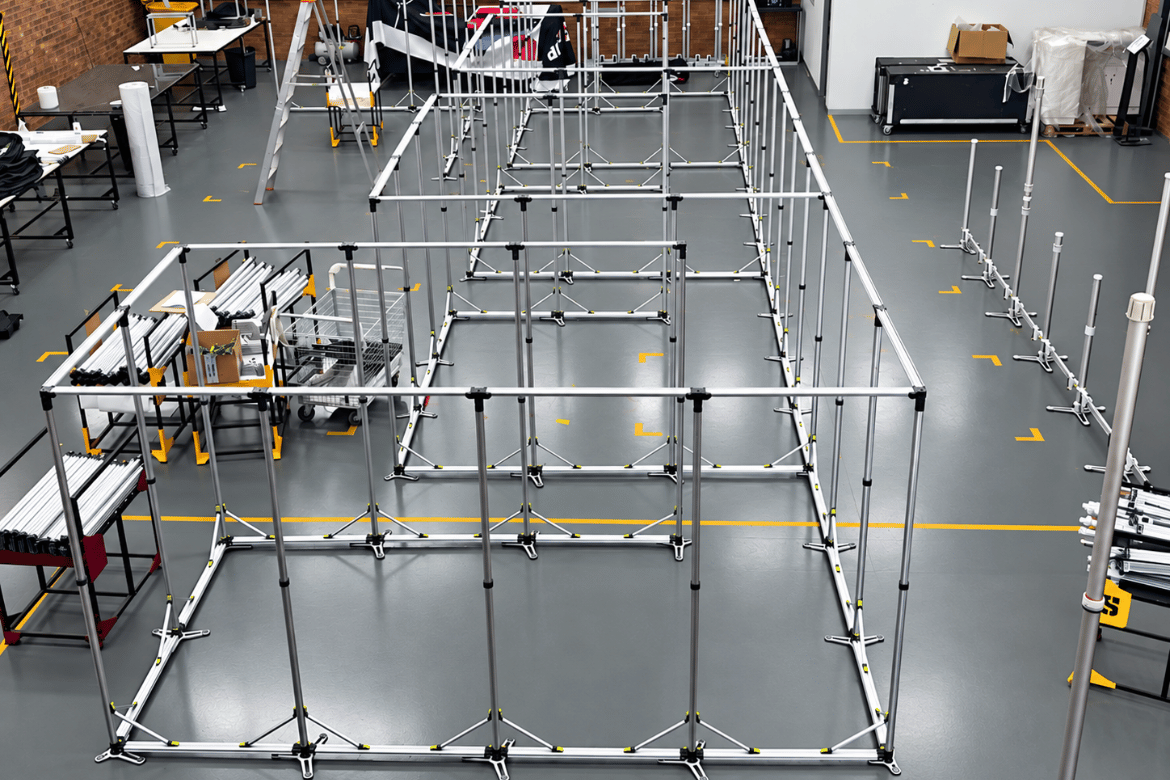
TRIGA®, for example, is built around a modular aluminium framework combined with tensioned textile graphics. The focus is on creating reusable structures that can be adapted for different layouts rather than manufacturing a completely new stand every time.
2. A Range That Covers More Than One Type of Project
Not every customer needs the same thing.
Some may require a simple branded backwall or portable display, while others need larger exhibition structures with screens, shelving, lighting or multiple walls.
A useful manufacturing partner should therefore offer enough flexibility within the product range to support both straightforward and more complex projects.
TRIGA® GO is suited to lightweight, portable applications, while TRIGA® MAX provides greater scope for larger and more detailed structures. Having different options within the same product family allows resellers to respond to a wider variety of briefs without sourcing completely different systems.
3. Reliable Technical Support
Even a good modular system can involve technical questions.
Customers may ask whether a particular configuration is possible, how a screen can be mounted, what size graphics are required or how different components can be combined.
That is where manufacturer support becomes especially important.
A good partner should be able to help with technical drawings, product specifications, configuration advice and more complicated project requirements.
For resellers, this means you can confidently offer more ambitious solutions without needing to solve every technical detail on your own.
4. Good Product Documentation
Clear documentation makes a significant difference when you are selling a technical product.
Look for a manufacturer that can provide accurate product information, assembly instructions, graphic specifications, CAD files or technical drawings where required.
This is not only useful for installation teams. It can also make quoting, design and customer presentations easier.
Good documentation reduces uncertainty and helps ensure that the final product performs as expected.
5. Replacement Graphics and Reusability
One of the strongest commercial benefits of modular display systems is the ability to reuse the hardware.
A customer may use the same structure for several exhibitions while changing the graphics for different campaigns, products or events.
When assessing a manufacturing partner, consider how easy it is to order replacement graphics and reconfigure existing hardware.
This creates additional value for the end customer, but it can also create repeat business for the reseller.
Instead of treating each project as a once-off stand sale, the relationship can continue through new graphics, accessories and additional components.
6. Consistency and Quality Control
Consistency matters when your own name is attached to the finished project.
Frames should fit together correctly, graphics should tension properly and replacement components should be compatible with previously supplied systems.
This becomes particularly important when customers expand an existing display over time.
A reliable manufacturer should maintain consistent specifications and quality across its range so that resellers can confidently supply additional components later.
7. Practical Logistics and Lead Times
Manufacturing quality is only part of the equation.
You also need to understand how products will reach you and your customers.
Ask about manufacturing lead times, packaging, international shipping, spare parts and the availability of commonly used components.
For international distributors in particular, good logistics can make the difference between a product being practical to sell and one that creates unnecessary complications.
A modular system that packs efficiently and is designed for transport can also help reduce freight and handling challenges.
8. Support for Resellers and Distributors
The best manufacturing relationships go beyond simply placing orders.
A manufacturer should understand that its distributors and resellers need tools to help them sell.
This may include product imagery, brochures, technical information, marketing material, training and guidance on the different applications of the system.
Access to these resources can shorten the learning curve and make it easier for a reseller to introduce a new product range to existing customers.
More Than a Supplier
The right exhibition display manufacturer should operate as an extension of your business.
You should be able to rely on them for product quality, technical knowledge and support when a project becomes more complex.
For resellers and distributors, this becomes even more important when the goal is to build a long-term display offering rather than simply fulfil occasional exhibition orders.
A modular system such as TRIGA® can support applications ranging from simple portable displays to larger exhibition environments, retail installations, showrooms and corporate spaces.
Choosing the right manufacturing partner means finding a company that can support that flexibility with consistent engineering, practical resources and dependable service.
When those elements work together, the relationship becomes more than a supply arrangement. It becomes a foundation for building a stronger and more versatile display business.