


How to Prevent Wrinkles in Fabric Display Banners
Wrinkles on fabric display banners can ruin your professional image. But don’t worry – keeping them smooth is easier than you might think. Here’s a quick guide to ensure your banners always look polished:
- Choose the right fabric: 100% polyester resists creasing and is durable for frequent use. Opt for 6.8 oz for trade shows or 9 oz for permanent displays.
- Store properly: Roll banners around a sturdy tube (never fold!) and keep them in a dry, climate-controlled space.
- Use tension frames: Systems like SEG or pillowcase tensioning naturally smooth out wrinkles during setup.
- Apply heat carefully: Use a steamer or hair dryer on low settings, or let sunlight and gravity do the work.
- Pack smartly: Roll banners with the printed side protected and use a hard case for transport.
Fabric Banner Weight Comparison Guide for Trade Shows and Displays
How to Remove Wrinkles from Banner, Flags, and Backdrops
sbb-itb-b68070b
1. Select Wrinkle-Resistant Fabric Materials
The fabric you choose plays a huge role in how much effort you’ll need to put into keeping wrinkles at bay. 100% polyester is widely regarded as the go-to option because its fibers naturally resist creasing. Unlike natural fibers, which tend to hold onto folds and wrinkles, polyester’s long-chain polymer structure allows it to bounce back to a smooth shape after being rolled or handled.
This durability makes polyester a perfect choice for banners that are frequently packed, transported, and set up. Plus, it absorbs light rather than reflecting it, giving you a matte finish that avoids glare under bright lights – whether at an exhibition or during photography.
1.1 Why Polyester Works Best for Display Banners
Polyester stands out for three key reasons: wrinkle resistance, durability, and weight. Its high tensile strength ensures it resists stretching and tearing, maintaining a smooth surface even when pulled taut on display frames. Unlike cotton or linen, polyester doesn’t absorb moisture, which means it avoids the structural changes that often lead to wrinkles.
“Polyester banners will survive being repeatedly rolled and installed, without showing signs of wear and tear.” – Endutex UK [10]
Another major advantage is polyester’s compatibility with dye sublimation printing. This process uses high heat – between 380°F and 420°F – to turn dye into gas, which bonds at a molecular level with the fibers. The result? Scratch-resistant, washable, and fade-resistant graphics that can last 3 to 5+ years with proper care [7]. And yes, you can machine wash polyester banners in cold water to freshen them up without worrying about losing color.
1.2 Recommended Fabric Weights and Weaves
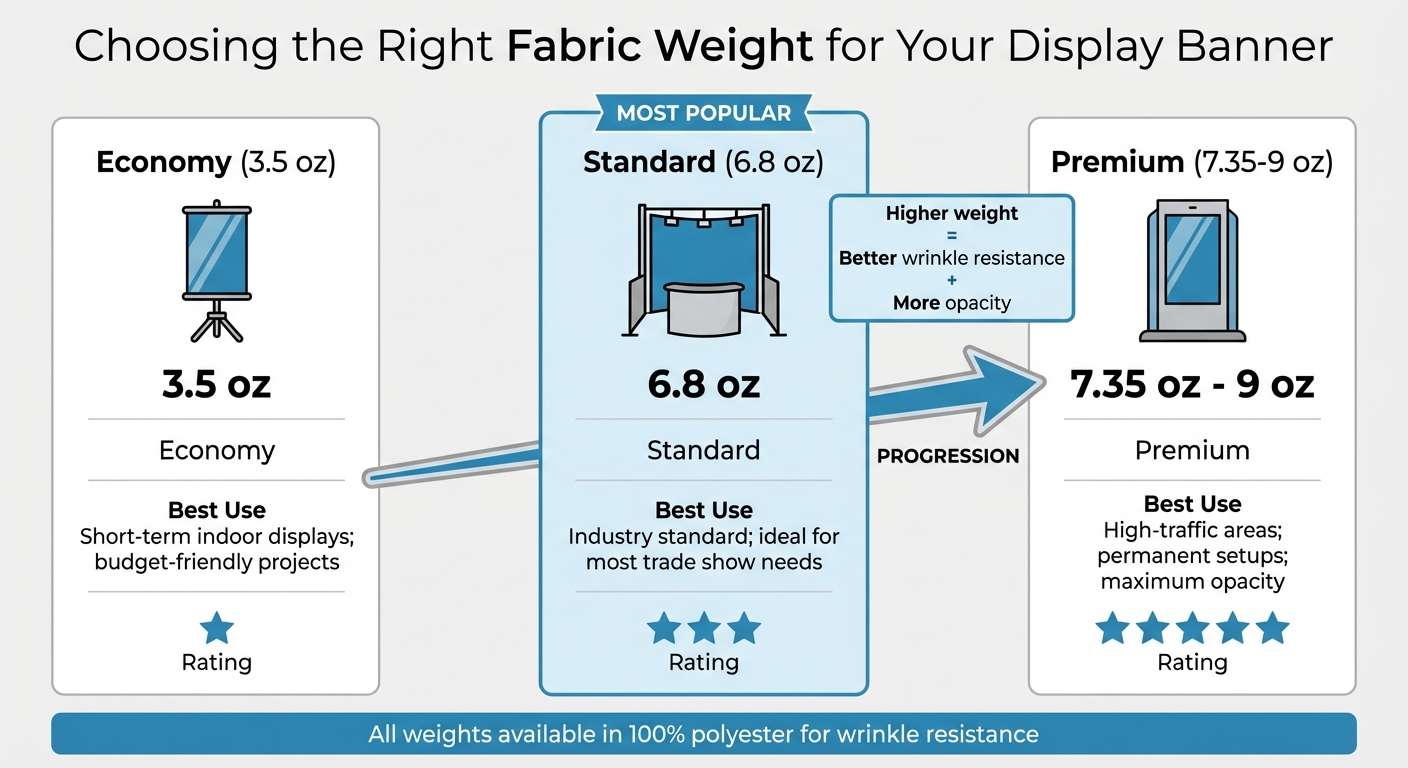
For professional trade show banners, 6.8 oz polyester is the standard [7]. It strikes the right balance between portability and wrinkle resistance during regular handling. For high-end corporate events or permanent displays where opacity is essential, 9 oz fabric offers even better wrinkle resistance and ensures no light bleeds through your graphics.
| Fabric Weight | Classification | Best Use Case |
|---|---|---|
| 3.5 oz | Economy | Short-term indoor displays; budget-friendly projects |
| 6.8 oz | Standard | The industry standard; ideal for most trade show needs |
| 7.35 oz – 9 oz | Premium | High-traffic areas; permanent setups; maximum opacity |
The weave of the fabric is just as important as its weight. High-quality polyester fabrics use a tight, three-layered weave with minimal gaps between threads. This design not only enhances opacity and print quality but also makes the material more resistant to creasing [8]. A tighter weave means your banners are less likely to develop fold lines compared to looser weaves. With a wrinkle-resistant fabric in place, the next step is ensuring proper storage to keep your banners looking flawless.
2. Store Banners Properly to Prevent Wrinkles
Storing banners the wrong way can lead to creases, even with wrinkle-resistant polyester. To keep your banners looking sharp and professional, it’s essential to store them correctly. Simple practices like rolling, maintaining the right storage conditions, and using hanging methods can help you avoid permanent creases.
2.1 Rolling vs. Folding Techniques
Folding is a big no-no for fabric banners. When you fold a banner, pressure points form along the folds, and over time, these can turn into creases that are nearly impossible to fix.
Instead, always roll your banners around a sturdy tube made of cardboard or PVC with a diameter of at least 3 inches [12]. For banners with digitally printed graphics, roll them with the printed side facing inward to shield the design. However, if your banner has raised vinyl lettering, roll it with the lettering facing outward to prevent crinkling [13]. Use fabric-safe tape to secure the ends – avoid regular adhesive tape, as it can leave sticky residue behind. Rolling your banners this way prevents the crease lines that folding creates.
2.2 Best Storage Conditions
The right temperature and humidity levels are crucial for keeping banners in top shape. Store your rolled banners in a climate-controlled area where the temperature stays between 60°F and 75°F and the humidity ranges from 40% to 60% [12]. This balance helps prevent mold while ensuring the fabric fibers don’t dry out and become brittle.
Steer clear of places like attics or basements, which often have extreme temperature fluctuations and excess moisture. Instead, opt for a well-ventilated closet or a dedicated storage room with stable conditions. Make sure the banner is completely dry before storing it – any lingering moisture can lead to mold, mildew, or unpleasant odors that are tough to get rid of [9][3]. Proper storage conditions protect the fabric and prevent wrinkles from forming.
2.3 Hanging Storage Methods
If you have enough vertical space, hanging storage is another effective option. Hanging allows gravity to work in your favor, naturally smoothing out minor creases. Use a curtain rod or a specialized rack to hang the banner by its top edge. This method is particularly useful between events, as it helps maintain the banner’s smooth appearance.
For an added touch, unroll and hang your banners for a day every few weeks to relax the fabric. Just make sure to hang them in a cool, dark room – prolonged exposure to sunlight can fade the colors. This simple hanging technique keeps your banners looking fresh without needing heat treatments.
3. Apply Tension and Gravity During Setup
Once your banner has been stored properly, the next step is setting it up using tension and gravity to smooth out minor creases. These methods work without the need for heat treatments. Pulling the fabric tight across a frame or hanging it vertically can naturally eliminate wrinkles, ensuring your display looks polished.
3.1 Tension Systems for Wrinkle-Free Displays
Tension frames are specifically designed to stretch fabric graphics, creating a smooth, wrinkle-resistant surface. Here are a few popular tensioning methods:
- Pillowcase Tensioning: This technique involves sliding a stretch-fabric graphic over an aluminum frame and securing it with a zipper, typically located at the bottom or side. The zipper pulls the fabric tight across the frame. For larger displays, it’s best to have two people work together to slide the fabric evenly over the poles, avoiding snags. Systems like TRIGA MAX even include patented tensioners for a perfectly smooth finish [16][17].
- Silicone Edge Graphic (SEG) Systems: These systems use a silicone strip sewn along the fabric’s edges. The strip fits into a recessed channel on the frame, creating a high-tension surface that’s virtually wrinkle-free. This approach also delivers a seamless, edge-to-edge look, making it perfect for premium displays [17].
- Mechanical Tensioning: Some frames come with adjustable knobs or levers, allowing you to tighten the fabric manually. Always tighten evenly around the edges and ensure the frame is properly aligned to avoid bunching or wrinkles [14].
These tensioning systems work hand-in-hand with good storage practices to maintain a smooth, professional appearance. Letting the banner remain under tension for a few hours can further relax minor creases. Polyester/elastane blends, commonly used in tension fabrics, are particularly effective at smoothing out over time. With proper care, these banners can stay wrinkle-free for up to five years when displayed indoors [14].
3.2 Using Gravity with Hanging Methods
Gravity can also play a role in smoothing out wrinkles during setup. When banners are hung vertically, their weight helps pull out creases, complementing tension systems. Gravity works best when the banner is suspended for several hours or overnight, allowing the fabric to relax naturally [11][14]. As Barry K. Brown, a sign and display expert at Visigraph, explains:
“Another option is to hang the banner up and allow gravity to naturally smooth out the creases over time” [11].
One effective method involves pole pockets, where the edges of the banner are folded and sealed to hold rigid poles. Always place a pole in the bottom pocket as well as the top. The bottom pole provides the necessary downward pull to keep the banner smooth and evenly tensioned [18].
For suspension displays, use steel cables, carabiners, and ceiling hooks to hang the banner. Ensure the setup is level to avoid creating stress lines [15]. If wrinkles persist, gently pull on the bottom corners or edges to help gravity settle the fabric [11].
Keep in mind that the fabric’s weight influences how effectively gravity works. Heavier tension fabrics, typically ranging from 6.0 oz/yd² (160 gsm) to 8.8 oz/yd² (240 gsm), respond better to gravitational pull [14]. By combining hanging techniques with gravity, you can achieve a smooth display that’s ready to impress.
4. Remove Wrinkles with Safe Heat Methods
When minor wrinkles linger, applying heat carefully can help restore a smooth finish while keeping the fabric intact.
4.1 Steamers and Hair Dryers
Using a steamer is often the safest way to smooth out fabric banners because it avoids direct contact with the material. Before starting, remove any poles or hardware to make handling easier, and work on the non-printed side to protect the ink and design [1][2]. Set the steamer to its lowest or “gentle” setting, hold it 4–8 inches away, and move it continuously to prevent heat from concentrating in one spot [2]. Andrea Gibbs, Creative Growth Lead & Senior Display Consultant at Lush Banners, explains:
“Steaming is generally safer for delicate materials, as it reduces direct contact and heat concentration” [1].
If using a hair dryer, stick to low or medium heat settings to avoid harming the fabric [2][4]. After heating, use your hand to smooth out the material and let it cool completely to set its shape. Ensure the banner is fully dry to prevent mold or mildew from forming [1][2][19].
For those who prefer to avoid mechanical heat, natural options can also help relax wrinkles.
4.2 Sunlight as a Natural Method
Sunlight provides a gentle, equipment-free way to ease out wrinkles:
“Exposure to natural sunlight is an excellent way to relax the creases” [5].
Start by cleaning the banner with a damp cloth and drying it thoroughly to prevent dirt from becoming embedded [5]. Lay the banner flat on a clean, smooth surface like a driveway or patio, ensuring it gets direct sunlight [20]. For quicker results, hang the banner vertically and attach light weights to the bottom grommets so both sunlight and gravity can work together [21]. Check on the banner every 30 minutes to ensure it doesn’t overheat. Fabric banners may take anywhere from 2 days to a week to smooth out, while vinyl banners often relax within a few hours to a day [20]. Once wrinkle-free, roll the banner for storage instead of folding it [20].
4.3 Safety Tips to Prevent Fabric Damage
To keep your banner in top condition, follow these safety precautions:
Always test any heat method on a small, hidden section of the banner before applying it to the entire surface [6]. If you notice shiny streaks forming, lower the temperature or move the heat source farther away immediately [4]. Avoid holding heat in one spot for too long:
“Never hold heat in one spot. Even low heat applied too long can warp or discolor the material” [2].
If you decide to use an iron, always place a thin cotton cloth between the iron and the banner to avoid direct contact. However, steaming remains the safer option [1]. For sunlight methods, remember that while sun exposure can effectively smooth wrinkles, extended UV exposure can fade colors, so store banners away from direct sunlight when not in use [5]. Lastly, avoid high-heat environments like car trunks or hot attics, as extreme temperatures can cause permanent damage [5].
5. Pack Banners Correctly for Transportation
Keeping your banners wrinkle-free from departure to setup starts with proper packing.
After ensuring the banner is set up and tensioned correctly, careful packaging is key to maintaining its flawless appearance during transit.
5.1 Rolling and Securing Techniques
Always roll your banner. Folding creates deep creases that can crack the material or leave permanent marks. As a reminder:
“The #1 Golden Rule of proper banner storage is to ROLL THE BANNER…NEVER FOLD!” [13]
Use a cardboard tube with at least a 3-inch diameter to roll the banner loosely. This prevents the material from retaining a curled shape [2]. For digitally printed banners, roll with the image facing inward. If your banner has vinyl lettering, roll it with the lettering facing outward to avoid damage [13]. Make sure the edges are aligned to avoid uneven rolling, which could lead to tears or creases [24].
Once rolled, secure the ends using fabric-safe tape to keep everything intact during transport [4]. Ensure the banner is completely dry before packing to prevent mold growth [9]. Also, avoid placing heavy items on top of rolled banners to protect their shape [2].
These steps work hand-in-hand with earlier storage tips to keep your banner looking its best.
5.2 Protective Cases and Bags
Hard plastic cases are excellent for protecting fabric banners from moisture, dust, and physical damage [22]. Cylindrical cases are ideal for retractable banners, while flat cases work well for compact storage of fabric banners. For heavy “step and repeat” banners that are transported frequently, wheeled or trolley-style cases can save you from unnecessary strain and reduce the risk of accidental drops [22].
For smaller, lightweight stand-up banners, sturdy fabric bags offer sufficient protection [22]. If professional cases aren’t an option, heavy-duty shipping tubes or the banner’s original box can serve as alternatives [13]. Whatever you choose, pack the banner loosely – tight packing can create new wrinkles, even in protective cases [23].
Conclusion
Keeping banners wrinkle-free comes down to smart choices in material, storage, setup, and transportation. Start with polyester – it’s a go-to option due to its wrinkle resistance and durability. When it comes to packing, roll your banners instead of folding them to avoid those deep creases that can weaken the fibers over time.
During setup, let tension-mounted frames and gravity do most of the work. As Lush Banners explains, “The safest and least damaging way [to remove wrinkles] is setting them up and letting the natural heat and tension do the job.” This process can take anywhere from 2 hours to 2 days. For faster results, a handheld steamer held 4–6 inches from the fabric can smooth out minor wrinkles effectively. Whether indoors or outdoors, these steps ensure your display looks polished and professional.
Focus on prevention instead of repair. Store banners in a temperature-controlled space (between 40°F and 80°F) to protect against moisture or brittleness. Handle them with care during setup to avoid transferring oils onto the fabric. For outdoor displays, sunlight and gravity can often handle small wrinkles naturally.
FAQs
Can I machine-wash a polyester fabric banner?
Machine-washing a polyester fabric banner isn’t a good idea, as it could harm the material. Instead, stick to spot cleaning with a mix of mild soap and cold water to keep it looking its best.
What’s the safest way to remove wrinkles without damaging the print?
The best way to smooth out wrinkles without harming the print is by using a low-heat steamer or iron. To protect the fabric, place a press cloth between the iron and the material. Make sure to avoid direct contact or using too much heat, as this could damage the print. Handle the banner with care to keep it in good condition.
How long does it take for wrinkles to fall out once the banner is set up?
When a banner is set up, wrinkles typically vanish within a few hours to a day. The time it takes can vary depending on factors like the type of material and the method used to smooth it out, such as applying tension or using steam.